
In 2014, I had the opportunity to go to Aceh to cover earthquake and tsunami warnings. Ten years after the 2004 tsunami, signs that the area had been hit by a devastating disaster almost disappeared by development.
Unlike the memories of the people who are still fresh about the disaster. One of them is the story of a densely populated island named Simeulue, this island is 150 km from the west coast of the city of Serambi Mekah.
Similar to other areas in Aceh in 2004, all buildings on the island were completely destroyed by the earthquake and tsunami. But surprisingly, this region is not like a mass grave like other areas in Aceh. Six people from Simeulue were killed. Imagine thousands of others able to save themselves to the highlands.
After being investigated, it turned out that the people on Simeulue Island had naturally responded to the disaster. That's because they have local wisdom as an alarm for tsunami and earthquake disasters. Understandably this area was hit by the disaster in 1907.
Simeulue residents call the tsunami a Smong. Smong becomes a poem that is often sung by Simeulue mothers when they want to put their children to sleep. A kind of lullabies. One of the pieces is:
Anga linon ne mali ... (If the earthquake is strong)
Uwek suruik sahuli ... (followed by low tide)
Maheya mihawali ... (Immediately search)
Fano me the tall lion ... (Your place is higher)
Ede smong kahanne ... (That's the name smong)
In Aceh, I discussed the local wisdom with a number of earthquake and tsunami experts. According to one of them, not only Aceh has such local wisdom. A number of coastal areas that have been hit by the tsunami also have traditional disaster mitigation. He mentioned one of them in Mandar, West Sulawesi.
I, as a Mandar person, was shocked to hear this information. Because I didn't get the information in my own village, but in a remote area.
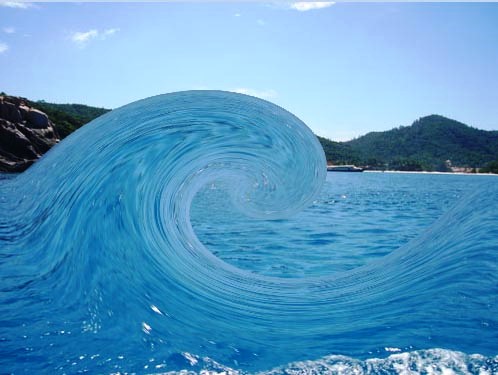
According to the expert, the tsunami in Mandar was known as Lembong Tallu (high waves of dozens of meters rolled three). The term is contained in the Mandar community's speech culture, both through poetry, the myths of the Mandar character, and through the posting or messages of parents.
The poems that mention Lembong Tallu include: Maui pole ox tallu sitonda talippurus, sumombal toa 'ma'itai dalle' yes hallal. (Even though the waves roll along with the pickaxe, I will still sail for halal sustenance)
Pukkali Malunda or KH Muhammad Husein, is a cleric in Malunda District, Majene who has a myth about Lembong Tallu. He is said to have prevented Lembong Tallu by just waving his shirt on the beach at Malunda (Munir, Muhammad. 2017, p. 413).
While the pappasang question about Lembong Tallu is often conveyed by parents to their children and grandchildren when they want to swim in the sea. My grandmother is included. He often said: Manyao. Diang bo'a Tembong Lallu, (Be careful not to get Lembong Tallu).
Unfortunately, local wisdom is gradually extinct in the West Sulawesi community, especially Mandar. I almost no longer heard the stories about Lembong Tallu at this time. Even though this local wisdom is actually the answer to the lack of natural disaster technology in West Sulawesi.
We must rebuke Japan, which in fact is a developed country, but utilizes its local wisdom to mitigate disasters. Japan, which is often hit by earthquakes and tsunamis, sees potential disasters from natural signs such as clouds. Local wisdom then enters the school curriculum so that it becomes a scientific analysis.
The West Sulawesi government is expected to be responsive to the cultural customs of its own people. Local wisdom of Lembong Tallu should be a guide in disaster mitigation. In order to no longer run out of energy drive the hoax about the tsunami.
TS Muzkaka
Reporter





Comments For This News (0)
Post a comment