
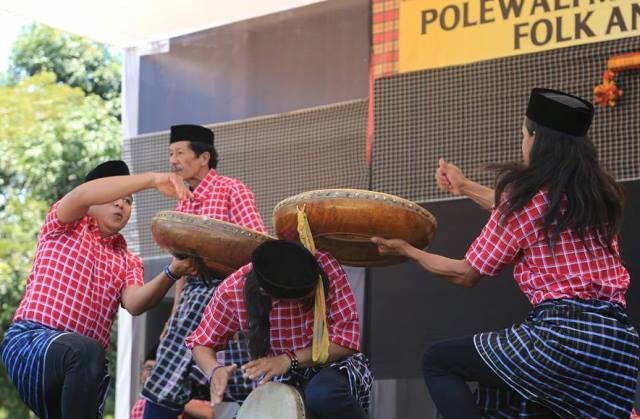
West Sulawesi is not only about beautiful beaches and culinary delights. The area, which is predominantly inhabited by the Mandar Tribe, also has cultural wealth, both dance, local wisdom, and traditional musical instruments. Although not many are familiar with it, some of these musical instruments are worldwide. For example, the tambourine which was popularized by parrawana towine Cammana to Singapore.
According to Raodah, who wrote a paper entitled The Existence and Dynamics of Traditional Mandar Music Performances in West Sulawesi (2019: 271), musical instruments with local materials are still in demand and are played at a number of events in West Sulawesi. Such as cultural performances, as well as in traditional ritual rituals. In the past, the Mandar people started making instruments and playing music to fill the silence while sailing and farming. They overcome the turmoil of life to the rhythm of the music. Because for the Mandar people, said Raodah, playing music is not a fun thing but an expression of the soul. The following are traditional Mandar musical instruments which are still preserved today.
1. Pompang
Pompang is a wind instrument or aerophone that emits sound with a range of 2 ½ octave scales. This instrument is made by combining large and small pieces of bamboo. Tall and large bamboos will usually give off a low note. on the other hand, bamboo cut into small pieces gives off a high note.
2. Tambourine
This musical instrument hit or membrafon in Mandar is called rawana. Rawana is a combination of Mandar and Arabic culture. This musical instrument player is called parawana. They usually show off their teeth at a number of events, such as the Khatam Al Quran ceremony, and sometimes collaborate with other musical instruments. Meanwhile, Syahribulan, as quoted from Raodah's paper, said that the existence of parawana became increasingly visible as the freedom of expression was being fulfilled. They sometimes appear at weddings, village rituals, regional carnivals, inauguration of village heads,
3. Gongga Lima
At first glance, the shape of Gongga Lima is similar to chopsticks made of bamboo. The way to play it is to hit it on the hand. This tool consists of the words gongga and five; gongga is the tool itself, while five represents the number of fingers on one hand. Gongga Lima, played by the Mandar people in Balanipa, is similar to Parappasa, an instrument from Gowa, South Sulawesi.
4. Pakkeke
This is a musical instrument with a distinctive sound. This tool, also known as Keke, is made of small bamboo. The end of the bamboo is wrapped around dried coconut leaves which give an interesting ornament to the final sound.
5. Calong
Its name is similar to calung, a traditional musical instrument from West Java which is both made of bamboo blades. The bamboo slats are firmly assembled onto the coconut fruit, forming a bowl. The coconut fruit functions as a container for sound, while the bamboo produces tones. According to records, classical calong only has four simple tones, different from the current one which has been modified to produce various tones. Previously, this instrument was played solo, aka individually. But now, there are times when several people play at one time.
6. Popondo
The people of South Sulawesi may be familiar with the name, because it is similar to their regional musical instrument called popondi. This tool is one string, with coconut shells being the resonator. Uniquely, in Mandar land, popondo or tolindo are played by young people to celebrate farmers entering the harvest season. The shape is no less eccentric, because it is similar to a buffalo horn resting on a coconut shell. As for the coconut, the device is paired.
7. Sattung
Both are made of bamboo, the difference is that bamboo for sattung must be dried first and then cut according to the segment so that the bones do not appear hollow. Only then are the ends of the bamboo tied so that they don't get damaged when you gouge them out. The cut results are then given a string wedge from end to end, while the center is perforated for resonance. Previously, sattung was played as entertainment, unlike now it is played during performance ceremonies.
TRIVIA





Comments For This News (0)
Post a comment