
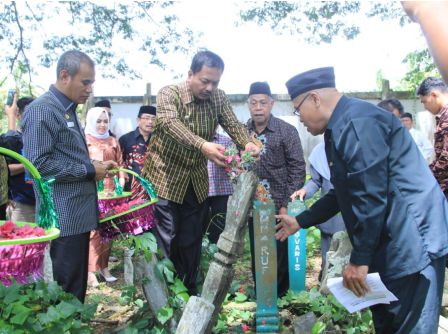
Polman, Sulbarkita.com -- Majene Regency Government commemorates the massacre of civilians at the 40,000 Victims Monument in Galung Lombok Village, Tinambung Subdistrict, Polman Regency on Saturday, February 2, 2018. Activities in the form of tomb shows and pilgrimages are a token of appreciation for the services of fighters who had died at that time.
According to Majene Regent, Fahmi Massiara, the Mandar ethnic massacre carried out by the Dutch colonizers 72 years ago was a form of international war crimes. "The International Court of Justice must provide a sense of justice for the victims and their families," he said in remarks.
Concerned about the incident, Fahmi also recommended to the West Sulawesi Provincial Government to set February 1 as a regional day of mourning. "We knocked on the heart of the West Sulawesi Provincial Government to immediately determine the day of mourning," he said. In addition, Fahmi hopes that the sacrificial monument of 40 thousand people can be used as a National historical site.
In line with Fahmi, a history subject teacher and researcher on the Galung Lombok massacre, Heri Herlina suggested that the incident be included in a history lesson at the School. "So that students know the patriotic history of the Mandar community. "The struggle for independence is not only in Java, we are not lovers of independence but freedom fighters," Heri said.
Heard the proposal, Assistant 1 for the Government of West Sulawesi Province, Muh. Natsir will deliver the recommendation to the Governor of West Sulawesi, Ali Baal Masdar. "This includes seeking the ownership status of 40 thousand monument land certificates and supporting the struggle for economic compensation from the Dutch Government," he said.
The activity was also attended by Former Regent of Majene, Kalma Katta and former member of the House of Representatives (DPR RI), General Ret. Salim S Mengga as a representative of the families of victims of the Galung Lombok massacre. As well as some of the top officials of Polman and Majene Regencies and community leaders.
History of the Galung Lombok Massacre
The slaughter in Galung Lombok or known as "panyapuang" by the surrounding community occurred on February 1, 1947, namely 2 years after Bung Karno read the text of the proclamation of the independence of the Republic of Indonesia. However, the Dutch invaders at that time returned to carrying out military aggression to the Sulawesi region led by Paul Raymond Westerling.
Arriving at Majene, the Dutch invaders received fierce resistance from the local population. Because of the inadequate weaponry equipment, the indigenous fighters were captured and thrown into prisons in Majene. Eventually the captives were herded into Galung Lombok, a distance of 5 kilometers, the purpose of which was to try and give fear to the population.
The Dutch colonialists also gathered residents to witness the trial, but there were reports of deterrence of Dutch patrol forces carried out by other fighters and resulted in several soldiers being killed sparking Wasterling's anger. And the incident happened, all the prisoners and residents present were hit by live ammunition.
Reporting from Kompas.com, July 13, 2013, Westerling special forces combing Majene and Polman areas, gathering and firing civilians in the Galung Lombok area, Tinambung District, Polman. The Mandar people were then shot blindly with their hands held in shackles. This tragedy includes the world's most violent massacre.
Muhammad Ashari





Comments For This News (0)
Post a comment