
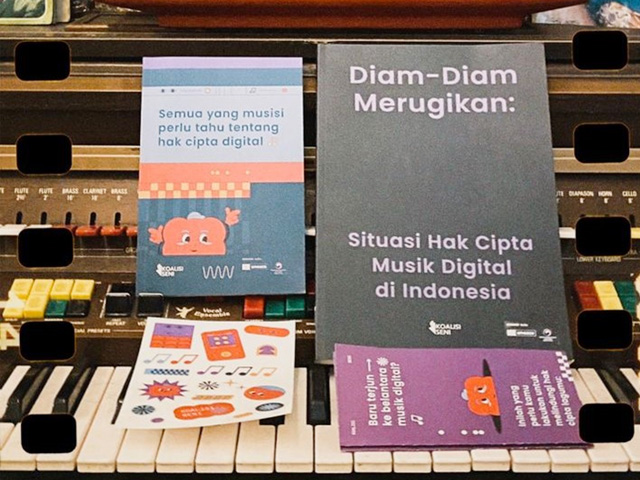
The Arts Coalition's analysis of regulations related to copyright in Indonesia shows that appreciation for creators and performers is not yet optimal. Existing policies actually make the position of musicians increasingly vulnerable.
Jakarta - The latest research by the Art Coalition “Silently Harming: The Situation of Digital Music Copyright in Indonesia”, found that the presence of digital music platforms is not matched by policies that can protect creators and their works. The existing regulations, namely Law Number 28 of 2014 concerning Copyright, have not yet responded to developments in the industry.
The law is not only biased towards music, but also does not specifically regulate digital music copyright, including the consequences of digitization which involve many actors. Even though now most musicians and songwriters in Indonesia release and promote their work on digital platforms. “Existing regulations actually give record labels privileges and allow intermediaries in the music industry to contract with musicians without concrete protection signs,” said Advocacy Manager of the Coalition of Arts, Hafez Gumay, in Jakarta, Thursday, May 25 2023.
The Art Coalition's research is a preliminary study of the situation of digital music copyright in Indonesia. For this research supported by UNESCO and KFIT, the Coalition combined literature reviews, interviews, as well as group discussions. Apart from that, today the Art Coalition also released a guidebook for musicians who are involved in the digital music industry. The free downloadable guidebook here explains, among other things, the definition of digital music industry players, musicians' rights, and types of royalties.
From its research, the Art Coalition found that the establishment of copyrights in Indonesia is far from the reach of most musicians. In fact, these musicians should be the main stakeholders. The birth of the Copyright Act in 1982 was driven by pressure from domestic industry and international trade organizations, with industry databases used to campaign anti-piracy rhetoric. This rhetoric forms paranoia in policies that place digitalization as an opportunity for the birth of a new model of piracy. "In fact, for many musicians, the main issue in the digital realm is how to create a digital royalty management system that is more transparent and takes their side," said Hafez.
A long history of paranoia about piracy of physical copies and technology has been one of the factors that has made copyright policy in Indonesia sluggish in regulating the realm of digital music. Policy still identifies "digital" as a format, not changing relations between actors and new roles in the music industry.
The logic behind the regulation of the Copyright Law is still based on physical analogy. “Policies are still focused on preventing piracy. Even though the Copyright Law regulates the means of controlling technology, new actors and relations in the digital music industry are not even considered in it," said Coordinator Researcher for Art and Culture Policy of the Art Coalition Ratri Ninditya.
From this research the Arts Coalition also found an exploitative industrial situation for musicians. There has been a shift in the pattern of commodification of music and ownership of copies, both physical and digital, to providing access to copies (streaming) giving rise to new actors such as aggregators, streaming platforms, intellectual property-based record labels (IP), record label 360, and music publishers. The relationship between musicians and new players in this industry is growing increasingly complex with various conflicts of interest.
Ratri explained, because the new relations that were created between these new actors were not all identified in the copyright policy, all relations that emerged were released to market mechanisms. "There are no clear guidelines in determining the minimum percentage that must be obtained by musicians," he said. The percentage of announcement royalties is determined based on an agreement between digital service providers (DSP), Collective Management Institutions (LMK), and publishers. Meanwhile, mechanical royalties are determined through private agreements between musicians and various intermediaries.
The third point of the Arts Coalition's research highlights the non-transparent management of royalties. Until now, for example, there is no obligation for LMK and National LMK to socialize musicians so they become members of LMK. The Arts Coalition survey in 2022 found that more than half of the respondents (59.6%) did not know who had collected the royalties. Most of the respondents know about the Copyright Law, but 41.3% of them have never read the Law. The survey also noted that 77.9% of respondents did not join the Collective Management Organization (LMK). As many as 36% of respondents did not know the obligation to join LMK if they wanted to receive announcement royalties. A total of 104 musicians became respondents to the Arts Coalition survey which was distributed online to networks and members of the Arts Coalition. Respondents consisted of creators, as well as permanent and non-permanent vocalists/instrument players.
The management of royalties is a complicated homework because a number of things have not been resolved. Until now, LMK has not been held responsible if the Song and Music Information System (SILM) does not meet the deadline. There is also debate about how far the government should be involved, and how LMK can function independently. While there are still those who question the transparency of LMK, the current LMKN commissioner must complete the transfer of the royalty collection function.
The fourth point of the Arts Coalition's research notes the problem of the weak bargaining power of musicians. Ratri explained, musicians have lost the ammunition to articulate their interests. The tendency of impartial policies makes musicians always the most disadvantaged party. "Digitalization has actually perpetuated the power imbalance between users and technology authorities, between musicians and DSPs, record labels, and intermediary parties," he said.
[*]
About the Arts Coalition
The Art Coalition is a non-profit organization that works to build a better arts ecosystem in Indonesia. To achieve its goals, the Arts Coalition advocates for arts policy, encourages the creation of an arts endowment, and strengthens knowledge management and networking between members of the organization.
The Arts Coalition bridges various stakeholders in policy advocacy to advance the arts ecosystem. The Arts Coalition has succeeded in pushing for the passage of the Culture Advancement Law, has also advocated for the Music Bill, compiled research on artistic freedom, and participated in capturing the aspirations of art ecosystem activists for the first National Cultural Strategy in Indonesia. The Arts Coalition has also passed on the concept of a cultural trust fund so that in 2021 the government is committed to allocating Rp. 3 trillion.
Members of the Arts Coalition contribute to improving their respective art ecosystems, as well as working to mainstream art as Indonesia's great asset. As of May 2023, the Arts Coalition has 350 members and individuals spread across 24 provinces.
For further information or interview appointments, contact: Isma Savitri, Communication Manager for the Arts Coalition (081-310-130-960) or email to isma@koalisiseni.or.id.
Follow the latest information about art policy at: www.koaalisaeni.or.id | promotion of culture.id | Instagram @koaalisaeni | Twitter @koaalisaeni | Tiktok @koaalisaeni





Comments For This News (0)
Post a comment