
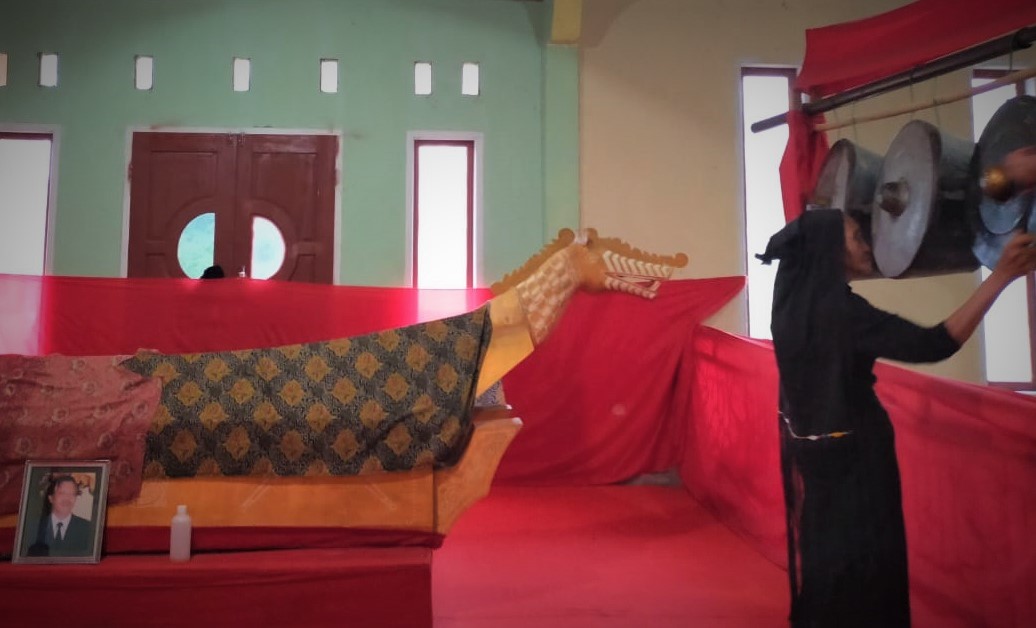
The boom of a gong greeted us at the funeral home of Paloli Pawa, a resident of Sapakuang Village, Balla District, Mamasa Regency, West Sulawesi who died on November 13 last year.
There, we sat in a circle in front of the late Paloli's coffin, which is typical of the Mamasa tribe. The crate is about 2 meters long. The wooden coffin is made to resemble a Mamasa traditional house, a rectangle covered with a pointed roof on both sides. There is a dragon's head carving on each side, symbolizing the triumph of the tribe in the mountains of West Sulawesi.
The body of the coffin is wrapped in red and black patterned cloth, typical of the Mamasa tribe, which is said to be rare nowadays. Photo of the late Paloli, who died at the age of 80, leaning against the side of the coffin looking dashing in a black suit. There was also Paloli Pawa's wife and sister sitting in all black clothes combined with a head covering called a pote'.
It is said that those who are often referred to as guards are not allowed to leave the room before the body is buried. The wife of the late Paloli and his brother also had to undergo the mero' ritual or fasting to eat rice while the body was still buried in the funeral home. "It is a form of grief," said Deni Pawa, the deceased's 5th child on Monday, June 7, 2021.
We came in a traditional Mamasa procession called Mangallung, which is a procession for the funeral of the body at the funeral home before being buried. According to local custom, new bodies can be buried for a minimum of 6 months to a year in an event called Rambu Solo, a funeral ceremony similar to that of neighboring Tana Toraja, South Sulawesi.
While in the house, the corpse is still considered "alive". Even served his favorite food every meal, such as rice complete with side dishes. At a certain time, four gongs were pounded by the guard. It is said that it is a symbol of consolation for the corpse. "Not just anyone who rings the gong. Only certain people," said Yenny Langitiboyong Buntuarruan, the son-in-law of the deceased.
The house which is undergoing the Mangallung procession is also quite striking because there is a drum in its yard. The size and shape of the drum is adjusted to the strata of the bereaved party. Meanwhile, the funeral home continues to be full of mourners. "Every night our house is crowded with relatives and friends," said John Richardes, the deceased's closest relative. The mourners, most of whom are residents of Sapakuang Village, continued Jhon, also paid tribute to the bereaved by not holding a festive wedding ceremony.
The Luxury of Solo Signs
The late Paloli Pawa was born on November 3, 1940 and died on November 13, 2020. According to customary provisions, the funeral ceremony for Rambu Solo will be carried out for a minimum of 6 months to a year at the funeral home. Therefore, the family of the late Paloli will hold the ceremony in November 2021.
Rambu Solo is a traditional funeral ceremony which contains the last respect for the departed deceased. In the journal Meaning of Costs in the Solo Rambu Ceremony, Tumirin and Ahim Abdurahim explain that this ceremony consists of three words, namely aluk rambu solo, namely aluk (belief), rambu (smoke or light), and descending. Thus, aluk rambu solo' can be interpreted as a ceremony that is carried out when the sun begins to fall (settling). As for literally means smoke that is directed downwards, which means the rituals of offering (smoke) for the dead which are carried out after 12 o'clock when the sun begins to move downwards.
The Rambu solo ceremony has begun around the 9th century AD and is carried out from generation to generation to this day. This funeral ceremony cost a lot of money. Because buffalo and pigs sacrificed can reach hundreds of tails. One of them is striped buffalo (tedong bonga) which is a kind of mud buffalo with black and white striped skin. This special buffalo is also priced thirty to fifty times higher than the price of an ordinary buffalo.
Muhammad Azhari
Correction:
Previously the funeral procession was called Mangallung, which is correct Mangallun





Comments For This News (0)
Post a comment